
Short answer: a 37 degree flare tool forms a single AN/JIC cone on the tube end, the fitting style used on braided racing lines, adjustable proportioning valves, and most aftermarket hose ends, not the 45° double flare that OEM steel brake pipe uses. Get the wrong tool for the fitting in your hand and the two can look close enough to bolt together and still leak, because the thread sometimes matches even when the flare angle doesn’t.
What “37 degree” actually refers to
It’s the angle of the cone on the end of the tube, measured off the tube’s centerline. AN and JIC fittings (the two names cover the same 37° geometry, AN is the military designation and JIC is the industrial one) seal metal to metal against a matching 37° seat inside the fitting nut, no flare washer, no crush ring. SAE brake pipe uses a 45° cone instead, and the seat it mates against is shaped for that angle specifically. Put a 37° flare into a 45° seat and the two cones only make contact along a thin ring near the tip instead of across the full face. It can look seated. It won’t hold pressure the way a matched pair does.
Where you actually run into 37 degree fittings
AN fittings show up on braided stainless lines, most remote reservoirs and adjustable bias valves, and anywhere a car’s been converted off factory hard line to a hose-and-fitting setup. Tube size is called out by dash number rather than a fraction: -3 is 3/16″ tube, -4 is 1/4″, -5 is 5/16″, -6 is 3/8″, -8 is 1/2″. A brake or clutch line on a car with AN plumbing is almost always -3 or -4. If someone handed you a car with braided lines already on it and you’re replacing a hard section that ties into them, you need a 37° flare on that end, not a 45°, even though the rest of the car might still be factory SAE everywhere else.
The thread trap
Here’s the part that actually costs people a line. The thread on an AN fitting isn’t unique to AN, it overlaps with SAE inverted flare thread at several common sizes:
- 3/16″ tube: both AN -3 and SAE 45° use 3/8-24
- 5/16″ tube: both AN -5 and SAE 45° use 1/2-20
- 3/8″ tube: both AN -6 and SAE 45° use 9/16-18
At 1/4″ they actually diverge, AN -4 is 7/16-20 against SAE’s 7/16-24, different pitch, and that one binds on the threads before it ever gets close to seating. But at -3, -5 and -6 the nut threads on smooth and tightens down with no resistance at all, because the threads genuinely match. The flare underneath doesn’t. You get a fitting that torques up fine and weeps or fails outright the first time the system sees real pressure, and by the time that shows up you’re bleeding a system you thought was done. Match the flare angle to the fitting before you cut tube, don’t trust that a thread spinning on cleanly means the seal is right.
Single flare, not double, and that’s not a shortcut
A 37° AN flare is formed in one pass, no fold-over step the way SAE double flare needs. That’s not the tool cutting a corner, it’s how the standard is built. AN fittings and the tube used with them are generally rated for higher pressure to begin with, and the 37° angle and the fitting nut’s design put more of the tube wall in contact with the seat than a 45° single flare would, so it doesn’t need the doubled wall thickness a 45° brake flare relies on to hold up long-term. Trying to double-flare a 37° cone just gives you a folded shape that doesn’t match the seat’s geometry at all.
What the tool has to do
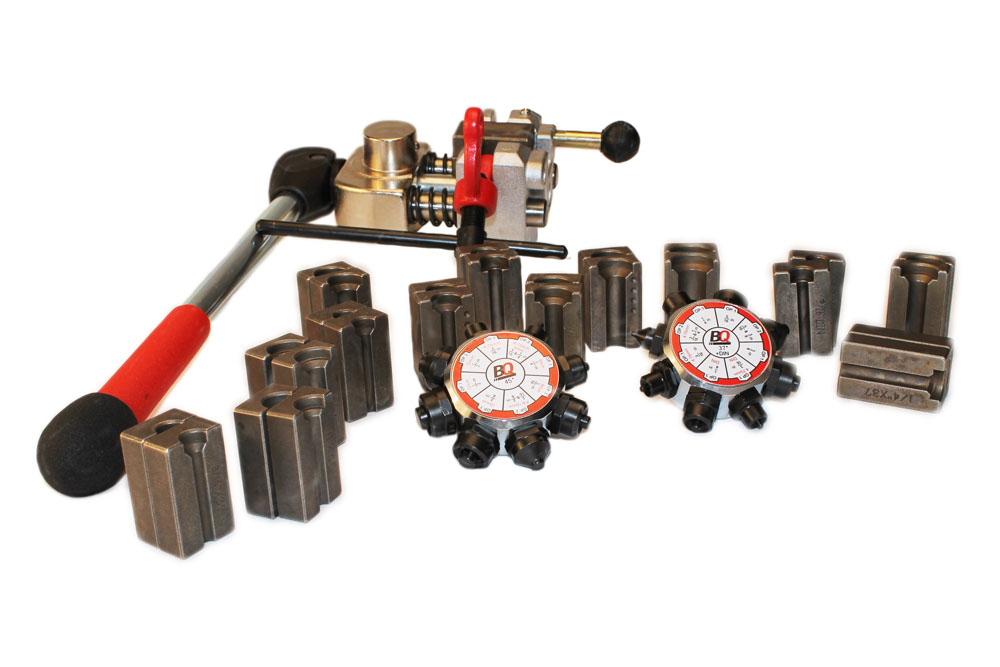
A flaring tool that handles 37° needs a die and punch cut to that exact angle, separate from whatever forms the 45° SAE cone. Most kits that only do 45° simply can’t produce a 37° flare correctly, the punch itself is ground to a different angle. You can’t get there by adjusting the depth stop on a 45° die. The BrakeQuip BQ350 Brake Tube Flaring Tool Kit covers 45° SAE, 37° AN, and metric DIN flares in one cam-lever tool with interchangeable turrets, so you’re not buying a second flaring tool the day a job turns out to have AN fittings on it instead of factory hard line. Set the tube to the depth the turret calls for and run the correct die, the tool won’t quietly form the wrong angle just because you clamped it in.
Check it before it’s buried in the car
Before you route the line, hold the fitting nut up to the finished flare and look at where the two surfaces actually touch. A correctly matched 37° flare and nut make contact across the whole cone face, evenly. If you can see daylight anywhere around the edge, or the nut only seems to touch right at the tip, stop and check that you’re actually using a 37° flare against a 37° seat and not a mismatched pair that happened to thread together. That five-second check costs nothing. Finding a weeping AN fitting after the line’s bled, clipped down, and the car’s back together costs the whole afternoon.