
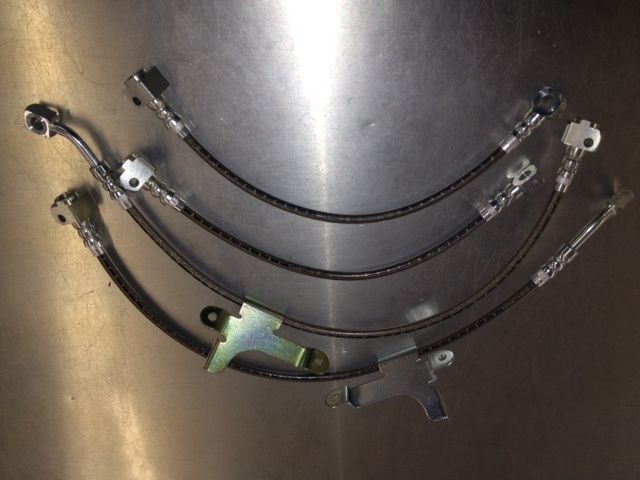
A Goodridge braided brake line is a rubber or PTFE hose sleeved in woven stainless steel, built to replace the factory rubber hose without ballooning under pedal pressure. The braid does one job: it stops the hose wall from expanding when the caliper piston pushes back against it, which is what gives a spongy pedal on an old rubber line even when there’s no air anywhere in the system. If you’re trying to work out sizing and fittings before you order a set, here’s what actually matters.
Why the hose itself is always -3AN
Braided line comes in AN sizes, and a brake line is almost always -3AN, meaning 3/16″ inside diameter. That holds whether it’s going on a Miata or a one tonne van. Fluid flow at a brake caliper is small compared to something like a fuel or oil line, so the hydraulic requirement doesn’t scale up with the vehicle. A -3 line moves enough fluid to actuate a caliper on anything from a motorcycle to a full size truck. If a listing offers -4 or -6 for a “brake” application, it’s usually meant for a remote reservoir breather or a clutch line, not the brake hose itself. Buy -3.
The hose is standard. The end fitting is where cars differ
Where fitment actually gets complicated is the end fitting, not the hose. Goodridge lines terminate in a banjo fitting at the caliper end and a male flare fitting at the hard-line end, and the thread on that male end depends on what the car was built with:
- 10mm x 1.0mm – the most common thread on modern and Japanese or European calipers and master cylinders.
- 7/16-20 UNF and 3/8-24 UNF – common on American cars and a lot of aftermarket calipers.
- 3/8-20 BSF (British Standard Fine) – what you’ll find at the caliper, master cylinder or T-block on a classic Triumph, MG, Jaguar, Austin-Healey or an early Land Rover.
The mistake: forcing a UNF fitting into a BSF port
BSF and UNF threads are close enough in outside diameter that a 3/8-24 UNF fitting will often start turning into a 3/8-20 BSF port by hand, for a thread or two, before it binds. That’s the trap. UNF cuts 24 threads per inch at a 60° flank angle. BSF cuts 20 threads per inch at a shallower 55° Whitworth angle. Force it past where it binds and you’re not tightening a fitting anymore, you’re cutting a new thread into soft brass or aluminum with a harder steel fitting. The port strips, the fitting never seals, and a ten minute line swap turns into a helicoil repair or a replacement caliper.
Check before you thread anything in. Count the threads over an inch with a scale, or run a thread pitch gauge across it if you own one. 20 threads per inch on a 3/8″ fitting means BSF. No gauge on hand? Thread a known UNF bolt in by hand first: on a BSF port it binds almost immediately instead of running in smooth.
Where the BSF fitting actually comes from
Most braided line kits, Goodridge included, ship with UNF or metric ends, because that covers the overwhelming majority of cars on the road. Nobody stocks a full BSF-ended line as a standard catalog item anymore. The practical fix on a British classic is to run the braided line to a UNF or banjo connection and adapt the last stretch, at the master cylinder or a T-block, with a fitting cut for the BSF thread the car was actually built with.
That’s what the BrakeQuip BQ4276 Brake Line Fitting is for. It’s a male 3/8-20 BSF fitting sized for 3/16″ tube, so you can terminate a hard line in the original BSF thread and marry it into a UNF or metric-ended braided line’s adaptor or T-block without stripping the port you started with.
DOT approval and fluid life
One more thing worth checking before you buy: not every braided line is DOT approved for street use, and the ones that are will say so on the hose or in the listing. DOT approval covers the hose’s burst pressure rating and how it holds up to the fluid itself, not just the braid. If the car sees the road, buy a DOT-rated line rather than a track-only PTFE line built for a car that gets fresh fluid every event instead of every few years.
Get the size right, it’s -3AN almost every time. Get the end thread right for the car you actually have. And check for a BSF port with a gauge or a test bolt before you force anything metric or UNF into it. That’s the whole job. The line itself is the easy part.