
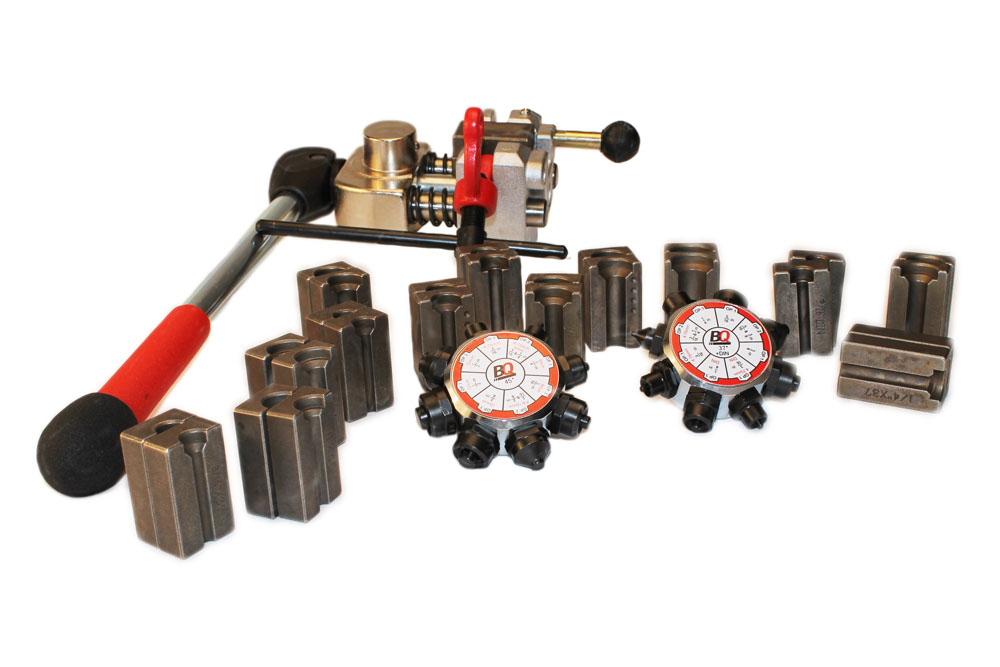
A flaring tool and a flare kit aren’t the same purchase. A tool is the ram and yoke that does the clamping. A kit is that tool plus the set of dies, adaptors and pilots that actually let it flare more than one size or shape. Search for “flare kit tool” and you’ll get a mix of both, and buying the wrong one is how people end up with a tool that can double-flare 3/16″ and nothing else, on a car that needs 1/4″ too.
What has to be in the box
A kit worth the name covers the sizes you’ll actually run into on a brake system, not just the one you’re fixing today:
- Dies or clamp bars for 3/16″, 1/4″, 5/16″ and 3/8″ – 3/16″ and 1/4″ cover almost every brake line on a passenger car or light truck built since the 1960s, 5/16″ and 3/8″ show up on fuel and transmission cooler lines and on bigger trucks.
- A forming die or adaptor for the flare shape your fittings use – SAE 45° double flare, single flare, and ISO/DIN bubble flare each need their own die. A kit that only ships SAE dies will flare a bubble fitting into something that looks right and doesn’t seal.
- A forcing screw and yoke rated to actually complete the stroke – the part that fails first on a cheap kit, covered below.
A kit missing any of those isn’t incomplete by accident, it’s a smaller kit sold at a smaller price, and you find out what it’s missing the day the job calls for it.
Why the yoke is the part that matters, not the dies
Every kit’s dies look roughly the same in a listing photo. The difference that actually shows up on the car is the yoke, the two-piece clamp that holds the tube square while the ram forms it. A cheap kit tightens that yoke with a single bolt or a wing nut, and if it isn’t dead square to the ram under load, the flare comes out lopsided: thicker on one side, thinner on the other. That flare can still look fine sitting on the bench. It shows up three months later as a slow weep at the fitting, not a clean failure you’d catch before buttoning the car back up.
The same weakness shows up as flex partway through the stroke. Forming a flare takes steady pressure through the whole motion, and a ram or yoke with play in it lets the tube shift mid-flare instead of holding still. The result is a crescent-shaped lip instead of a symmetrical cone, and it’s not something you’ll spot by eye at the bench. You’ll spot it on the bleeder screw, wondering why a line you just replaced is weeping.
Stainless is where a light kit gets found out
Stainless brake line work-hardens fast. It resists forming right up until it doesn’t, and then it cracks exactly at the fold instead of forming a clean cone. A kit built around mild steel and copper-nickel tube can crank down a stainless flare that looks complete and comes apart the first time it’s torqued to spec. This is why a stainless-rated kit is its own category and not just a marketing sticker: the clamp force and the die finish both have to be better to keep the tube from splitting, not just harder steel in the dies.
If there’s any stainless line anywhere in the job, check that up front. The BrakeQuip BQ351 Brake Flare Tool Kit covers 3/16″, 1/4″, 5/16″ and 3/8″ tube in SAE 45° double, single and 3/16″ DIN bubble flare, in one case, and it’s built to run stainless without cracking the flare. A drop of oil on the die and it goes through steel, copper-nickel or stainless the same way.
The mistake that costs a redo, not just time
The most common thing that goes wrong with a flare kit isn’t the tool, it’s skipping steps the kit assumes you’ll do. Deburr the tube’s cut end before it goes in the die, inside and out. A burr left in the ID keeps the flare from seating flush against the fitting even when the flare itself is formed correctly, and it reads exactly like a bad flare when it starts weeping. Same with the length of tube left proud of the die before you start the ram: too little and you get a thin, torn flare, too much and it folds over unevenly. Both are kit-agnostic mistakes, and a better kit doesn’t fix either one on its own.
What a good kit does fix is the failure mode that isn’t your fault: a die that doesn’t match your fitting’s flare shape, or a yoke too loose to hold the tube square. Those aren’t technique problems. They’re the kit being the wrong one for the job, and no amount of care on the bench gets around them.
What it actually costs to get this wrong
A bad flare caught on the bench is a few inches of scrap tube and five minutes to cut and try again. A bad flare that gets bled, bolted up and the car put back together is a comeback: pull the wheel, chase down which line is weeping, cut it back past the bad flare, and redo it with the car already reassembled instead of in pieces. The kit is the cheapest part of the whole job. Buying light to save on it almost never actually saves anything once the redo is counted in.